
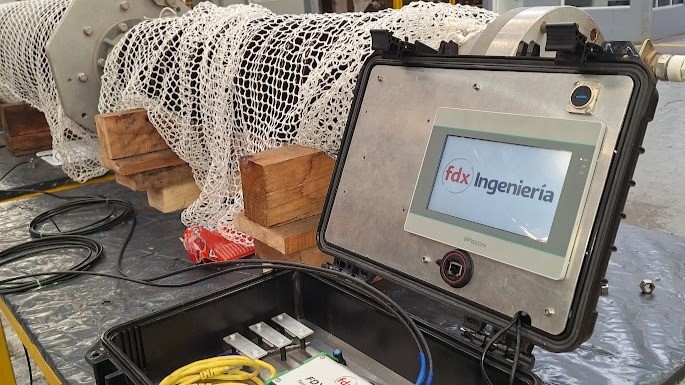
In the high voltage industry, equipment reliability and performance are key factors to ensure a safe and efficient power supply. In this context, we performed a hot spot test at rated current on a 132 kV disconnector insulated in SF6, complying with IEC 62271-1 standards.
Test Objective
The purpose of this test was to evaluate the thermal behavior of the disconnector under real operating conditions, ensuring that the temperature values remained within the admissible limits established by the regulations.
Challenges in Performing Thermal Tests
Thermal testing of high voltage equipment presents multiple challenges. Traditionally, RTD sensors are used, which require wooden structures to simulate ceramic insulators or, in some cases, the adaptation of an old insulator perforated to allow the passage of sensor cables. However, these solutions can alter the actual thermal conditions of the equipment, affecting the accuracy of the measurements.
FDX-HS System: An Innovative Solution
FDX-HS system provides an efficient solution by using passive sensors based on patented RFID technology. This technology allows temperature measurement without wired connections between the monitoring unit (FDX-HS-CM) and the sensors, maintaining electrical safety distances and mechanical barriers. This makes it an ideal choice for monitoring hot spots in electrical equipment.
In this test, the disconnector had to remain completely sealed to prevent SF6 leakage. Thanks to the FDX sensors, we were able to accurately measure the temperature at the following critical points:
- The moving part of the disconnector.
- The fixed part of the disconnector.
- The arcing contact.

Sensors on the central contact

All this was achieved without disturbing the porcelain insulation, allowing accurate and reliable data collection without affecting the performance of the equipment, even in the presence of SF6.
Benefits of Real-Time Monitoring
The ability to monitor temperature in real time offers multiple advantages.
- Increased accuracy in the thermal assessment of equipment.
- Reduced risk by avoiding direct interventions on insulation.
- Optimized maintenance, allowing early detection of anomalies before they become critical failures.
Conclusion
The use of RFID-based temperature sensors represents a significant advance in high-voltage thermal measurement. This innovative solution offers real-time, highly accurate data, optimizing maintenance processes and improving operational reliability.
Interested in learning more about these solutions? Reach out and let’s chat!
#Engineering #HighVoltage #SF6 #Monitoring #ElectricalTesting #FDX FDX Axzon Edenor Ema Electromecánica S.A.